


How Competitive Benchmarking in AI Can Transform Marketing Strategy
Brands have long measured competitors through search rankings, keyword overlaps, and backlink profiles. But the rise of generative AI is redefining how competitive analysis works.
Today, AI assistants are increasingly guiding users before they ever visit a website. People ask questions, compare solutions, and explore options directly through AI systems.
As a result, brand visibility inside AI-generated responses is becoming a new frontier for competitive benchmarking.
What Is AI Share of Voice?
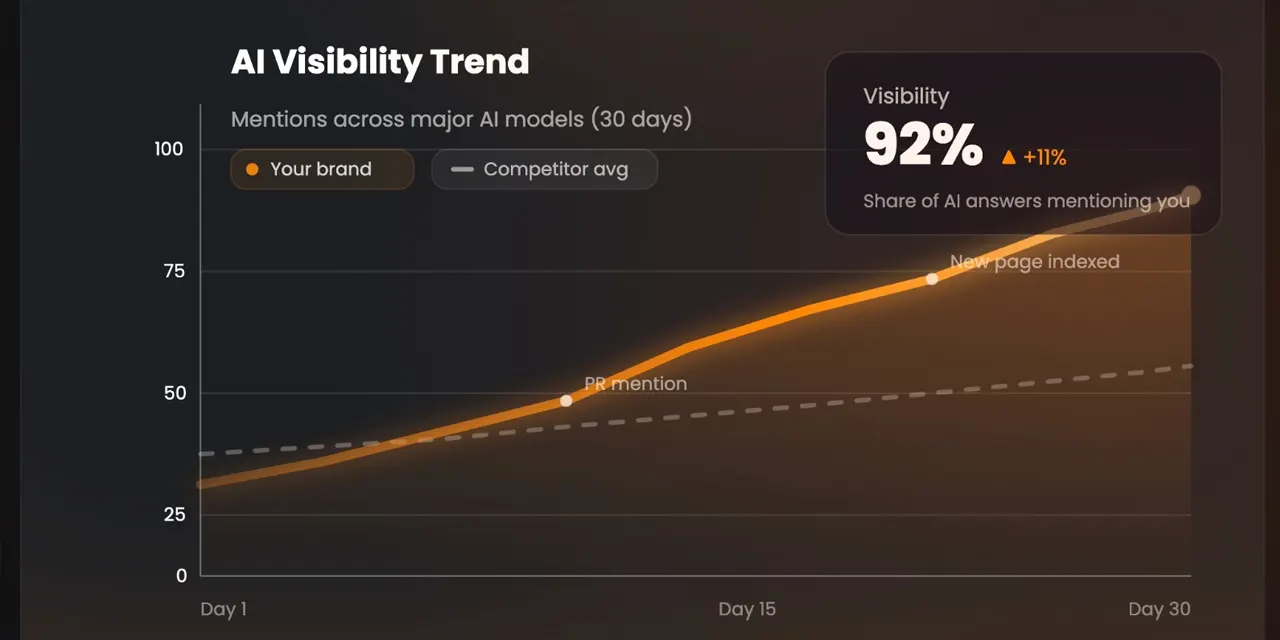
AI Share of Voice refers to how often your brand is referenced in AI-generated answers compared to your competitors.
It is conceptually similar to traditional share-of-voice metrics used in advertising and SEO. However, instead of measuring exposure across media channels or search results, AI Share of Voice focuses on how frequently brands appear in responses generated by AI assistants.
When a user asks an AI assistant for recommendations — for example, tools for marketing automation or platforms for project management — the assistant often suggests several companies. Measuring how frequently your brand appears in these responses provides a new way to understand competitive positioning.
Several emerging analytics tools are beginning to explore this space. For example, platforms such as BuzzSense analyze how brands appear across AI assistants and compare visibility between competitors.
Why AI Share of Voice Matters
Generative AI assistants are increasingly involved in:
- early-stage research
- product comparisons
- solution recommendations
- purchase exploration
This means that many users encounter brand recommendations before visiting search engines, review sites, or company websites.
If AI assistants frequently recommend your competitors but rarely mention your brand, that insight can reveal a new kind of visibility gap.
What AI Competitive Benchmarking Enables
- 1. Deeper Understanding of Audience Intent
By analyzing the types of questions that trigger brand mentions, companies can better understand how AI systems interpret user intent and which brands are associated with particular needs or solutions. - 2. More Effective Content Strategy
When organizations understand which sources influence AI-generated responses, they can adjust their content strategies to strengthen credibility and authority in those areas. - 3. Clearer Market Positioning
Benchmarking visibility across competitors helps companies see how AI systems present the market landscape to users. This can reveal shifts in perception that traditional metrics may not capture.
From Insights to Action
Understanding AI Share of Voice is only the first step. The next step is acting on the insights.
Organizations can use these insights to:
- improve content that informs AI-generated answers
- strengthen authoritative citations and references
- expand presence across trusted sources that influence AI responses
Rather than competing only for search rankings, brands increasingly need to understand how AI systems represent them in conversations with users.
Looking Ahead
As AI assistants become a more common starting point for discovery, the ability to measure and benchmark visibility inside AI-generated answers will likely become an important part of digital strategy.
For marketers and product teams alike, AI Share of Voice offers a new lens through which to understand competitive dynamics in an AI-driven information ecosystem.